Inside the China E-Bike Supply Chain: Motors, Batteries, OEM/ODM and Where Value Is Created
How China’s e-bike supply chain works from motors and batteries to frames, final assembly, OEM/ODM development and compliance — and where suppliers can create more value.
China’s competitive advantage in e-bikes is not one factory or one cheap component. It is the density of the supply chain. A brand can source frames, motors, controllers, batteries, displays, chargers, lighting, brakes, wiring and final assembly from specialized suppliers within a relatively concentrated manufacturing ecosystem.
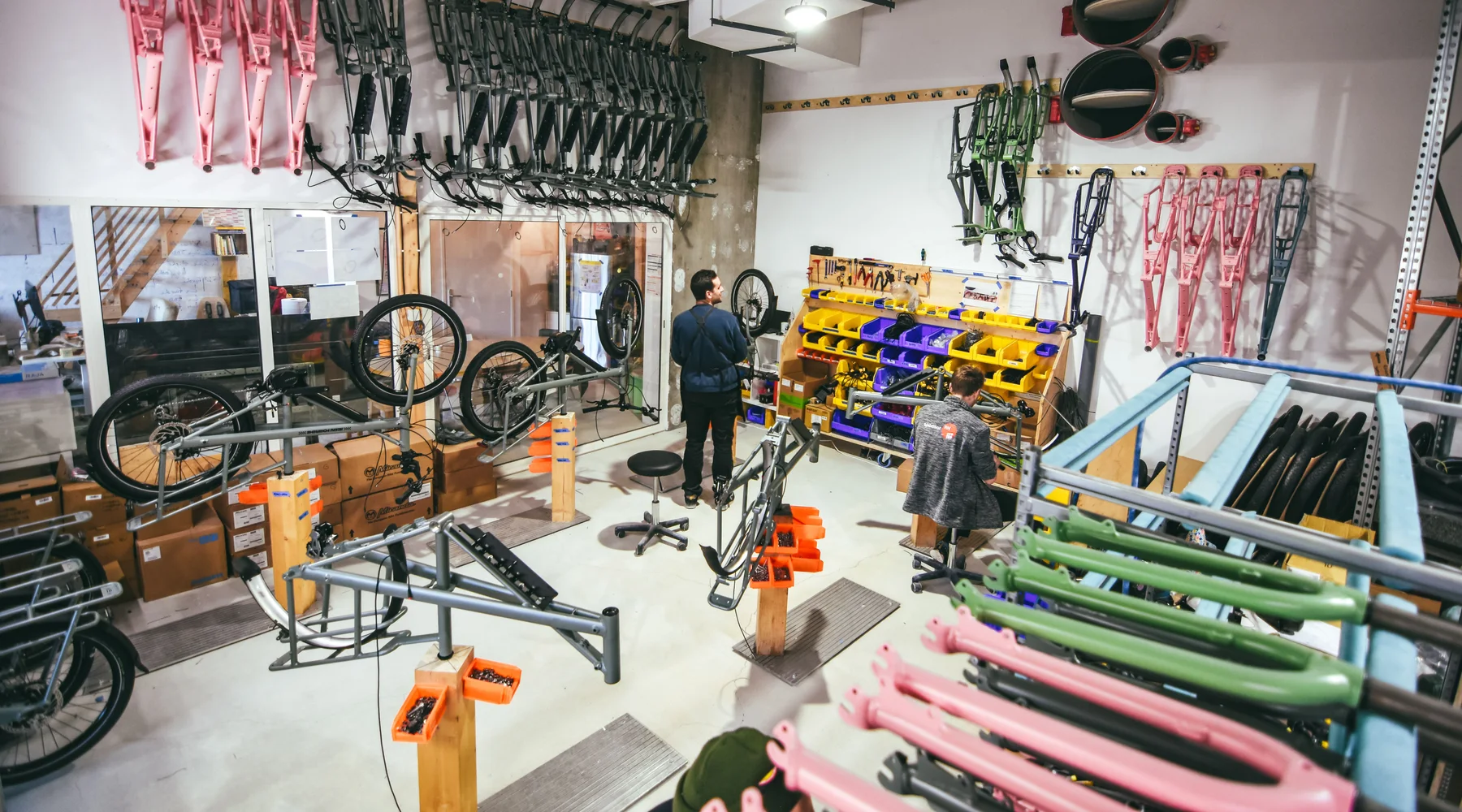
That density reduces development time and makes it possible to launch products at price points that are difficult to reproduce in less mature supply bases. But it also means many brands can access similar components. The competitive frontier is shifting from simple assembly toward engineering integration, software, compliance and after-sales support.
The e-bike is a system, not a bicycle plus a motor
A modern e-bike contains several interconnected layers:
- mechanical bicycle platform;
- electric motor;
- controller and power electronics;
- battery pack and BMS;
- sensors;
- display and user controls;
- charger;
- wiring harness;
- firmware and apps;
- compliance and traceability data.
An OEM can buy all of these as separate components, but the finished product quality depends on how well they work together.
Motors: from commodity hubs to premium systems
China supplies an enormous range of motor technologies. Low-cost rear hubs remain central to affordable commuter, folding and fat-tire bikes. At the other end, Chinese engineering now competes directly in premium mid-drive systems.
Bafang, founded in 2003, is a useful example of the supply chain’s evolution. The company says its head office, development and manufacturing center is in Suzhou and that it now operates sales/service sites across Europe, the U.S. and Asia, plus a production facility in Poland focused on European mid-drive systems.1
Its portfolio spans front and rear hub motors, mid-drives, batteries, displays, sensors and controllers.2 That allows an OEM to source a complete drive ecosystem rather than integrating unrelated components.
Avinox pushes the premium boundary further. Its current systems include mid-drives with peak outputs up to 1,500W in specific M2S configurations and torque up to 150Nm in Boost mode, while software limits speed by region.3
Batteries: cells are only the beginning
Many e-bike brands talk about battery cells because recognizable cell manufacturers are easy to market. But the pack assembler creates much of the real product risk.
Battery-pack quality depends on:
- cell grading and consistency;
- busbar design and welding;
- BMS hardware and firmware;
- fuse architecture;
- enclosure sealing;
- thermal sensing;
- connector quality;
- pack mounting;
- charger compatibility;
- end-of-line testing;
- traceability.
China’s new GB 43854-2024 mandatory battery standard illustrates how seriously regulators now treat pack-level safety.4
For export customers, UL, EN and EU Battery Regulation requirements add additional layers.
Frames and complete-bike platforms
The frame is where OEM and ODM business models become visible.
In a basic OEM relationship, the customer provides a developed design and the factory manufactures it. In real e-bike sourcing, the line is often blurrier. Many suppliers maintain existing frame platforms that can be customized with geometry changes, battery covers, racks, paint, displays and component choices.
That is closer to an ODM/platform model: the supplier owns much of the base engineering and the brand configures it.
Platform sourcing is fast and inexpensive, but it can create look-alike products. Multiple brands may sell bikes with similar frames, batteries and motors under different names.
Where value is created in an OEM project
The lowest-value part of the chain is simple assembly. Higher-value suppliers solve integration problems.
Examples include:
- designing a battery enclosure that passes vibration and ingress testing;
- tuning torque-sensor response for a specific bike category;
- validating brake performance at maximum payload;
- routing harnesses to avoid chafing;
- optimizing firmware for range and thermal protection;
- preparing certification samples and technical files;
- maintaining spare parts after mass production ends.
These tasks are difficult for a buyer to replace by shopping for a lower-cost factory every season.
Domestic scale supports export competitiveness
China’s enormous domestic e-bike market gives suppliers volume even when export demand is soft. The State Council reported about 8.47 million e-bikes purchased through the national trade-in program in the first half of 2025, with sales value around RMB 24.77 billion.5
The same report said production among the top ten brands rose around 27.6% year over year during the period.5
This scale supports high-volume supply of batteries, motors, controllers and commodity parts.
The cluster advantage
E-bike manufacturing is distributed across several Chinese industrial regions rather than located in one city. Suzhou and the Yangtze River Delta have deep electronics and motor capabilities; Tianjin has a long history in bicycle manufacturing; Guangdong offers electronics, batteries and export manufacturing; Zhejiang is strong in bicycle and light-electric-vehicle supply chains.
The practical advantage is supplier proximity. When a motor connector, display mount or battery enclosure needs revision, an OEM can often work with specialized vendors without rebuilding the whole supply chain.
Compliance is becoming a product feature
The industry used to treat compliance largely as certification near the end of development. That model is becoming risky.
Current requirements increasingly affect the architecture itself:
- China’s GB 17761-2024 strengthens anti-tampering and fire-related requirements;6
- U.S. markets increasingly demand recognized electrical-system and battery safety certification;7
- the EU Battery Regulation introduces digital battery passports for LMT batteries from February 2027.8
A supplier with mature documentation, serial traceability and engineering change control can therefore command more value than a factory that only builds hardware.
Software is the next supply-chain layer
Displays and apps used to be accessories. They are now part of the product experience.
Modern systems can offer navigation, theft protection, OTA updates, ride logging, motor tuning and battery diagnostics. Avinox’s 2026 software releases, for example, added navigation support, maintenance mode, battery-temperature display and other connected functions across compatible hardware.9
That shifts bargaining power toward suppliers that own firmware and system integration. A brand dependent on closed third-party software may have limited control over future features and support.
How buyers should evaluate a supplier
A useful factory audit should cover more than capacity and unit price. Ask:
- Which parts are made in-house?
- Which critical components are subcontracted?
- Who owns the frame tooling and CAD?
- Who owns firmware source code or configuration rights?
- How are engineering changes approved?
- How are battery serial numbers tracked?
- How long are spare parts supported?
- Can certification records be linked to exact production BOMs?
- Can the supplier provide EU battery-passport data?
- What happens if a motor or cell supplier discontinues a component?
The answers show whether the supplier is an assembler or an engineering partner.
Bottom line
China’s e-bike advantage is a system-level manufacturing ecosystem. Cheap labor alone does not explain it. The deeper advantages are supplier density, domestic scale, electronics capability and fast product iteration.
As compliance and software become more important, the strongest suppliers will be those that move beyond assembly and take responsibility for integration, documentation, traceability and lifecycle support.
Sources
Image: Jean Fourche / Pexels, used under the Pexels license.
Footnotes
-
Bafang, Company. https://bafang-e.com/en/about-bafang/company/ ↩
-
Bafang, official website. https://www.bafang-e.com/ ↩
-
Avinox, Drive System FAQ. https://www.avinox-ebike.com/avinox-system/faq ↩
-
China National Standard Information Public Service Platform, GB 43854-2024. https://openstd.samr.gov.cn/bzgk/std/newGbInfo?hcno=E14253B5634B9F3E9D243E27E1060A0C ↩
-
The State Council of the People’s Republic of China, trade-in statistics. https://english.www.gov.cn/archive/statistics/202507/03/content_WS68668845c6d0868f4e8f3d06.html ↩ ↩2
-
China MIIT, explanation of GB 17761-2024. https://www.miit.gov.cn/jgsj/xfpgys/qg/art/2025/art_b9cc3e2d6ea34c6caba99329614a3cda.html ↩
-
UL Solutions, UL 2849 overview. https://www.ul.com/services/e-bikes-certificationevaluating-and-testing-ul-2849 ↩
-
Regulation (EU) 2023/1542. https://eur-lex.europa.eu/eli/reg/2023/1542/oj ↩
-
Avinox, Downloads and release notes. https://www.avinox-ebike.com/avinox-system/downloads ↩