 China eBike
E-Bike Battery Weight: How Pack Mass Affects Range, Handling, and Portability
Learn how e-bike battery weight relates to capacity, handling and portability, and which removable-pack specifications matter most.
Battery weight matters most when it changes something you do regularly: carrying a pack upstairs, removing it for indoor charging, lifting the bicycle onto a rack, or managing the bike at low speed. It is not, by itself, a verdict on battery quality or range.
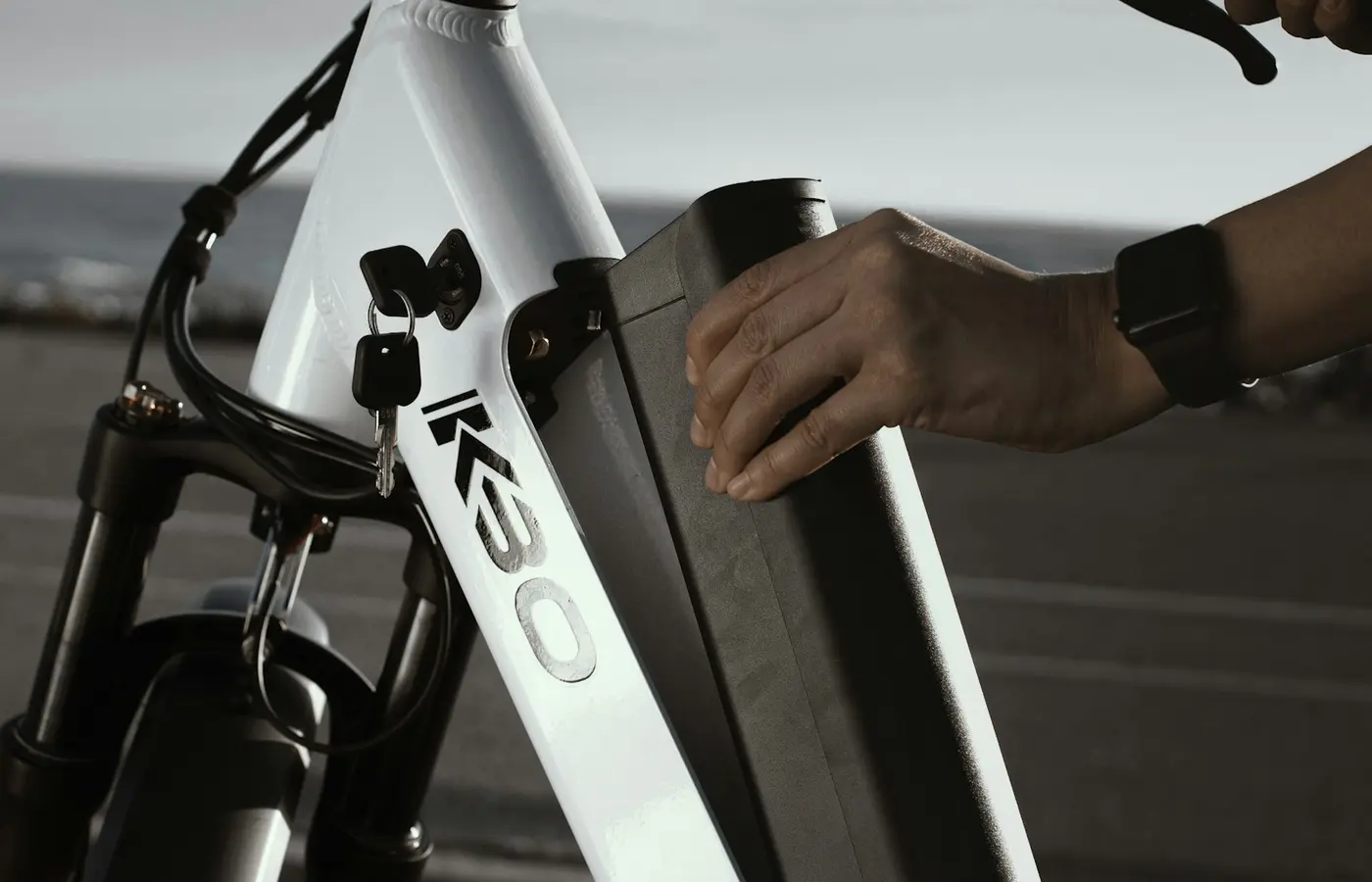
A larger battery can make sense for long commutes, touring, cargo use or infrequent charging. A smaller pack can be the more practical choice when the battery must come indoors every day or when the whole bike must be lifted often. The useful question is therefore not simply, “How heavy is the e-bike battery?” It is: how much energy, size and day-to-day inconvenience does that mass represent in this particular bicycle?
Start with the ownership routine, not the number on the scale
Before comparing specifications, identify how the bicycle will be charged and moved.
A rider with secure ground-floor charging may rarely carry the battery separately. In that case, a higher-capacity pack may be a reasonable range trade-off, provided the complete bicycle remains manageable. Someone in an upstairs flat, by contrast, may remove and carry the battery after nearly every ride. For that rider, the shape, grip and removal process can matter almost as much as the stated mass.
Battery weight also has different consequences in common use cases:
- Daily commuting: A removable battery can make indoor charging easier, but it must be convenient enough to remove and carry repeatedly.
- Leisure and touring rides: More stored energy may reduce charging stops, while extra battery mass is less important if the bike is not carried often.
- Folding bikes and multimodal trips: Pack dimensions, the complete bike weight and whether the battery has to be removed before folding or lifting can all be decisive.
- Cargo and family transport: The bicycle already carries variable loads, so battery placement and overall load distribution deserve particular attention.
- Importing or fleet purchasing: A pack should be evaluated as a serviceable system, including replacement availability, compatibility documentation and warranty terms—not only as a Wh and kg figure.
Published specifications should be the starting point. Look for battery energy in watt-hours (Wh), stated pack mass, dimensions, mounting location, removability and the applicable model year. The owner manual is often more revealing than a product-page summary because it may show the actual removal direction, lock operation and charging procedure.
What determines e-bike battery weight?
An e-bike battery is a complete assembly, not just a group of cells. Its weight can include:
- lithium-ion cells that store energy;
- a battery-management system (BMS), which monitors and controls the pack;
- wiring, connectors and protection components;
- a housing designed to fit the bicycle and resist routine use;
- rails, locks, mounting interfaces or other hardware; and
- in some designs, structural or protective elements required by the frame integration.
The most useful capacity figure for a buyer is usually watt-hours. Wh describes energy storage and is commonly calculated from nominal voltage multiplied by amp-hours. A 500 Wh pack is intended to store more nominal energy than a 400 Wh pack, but Wh alone does not state the real-world distance the bicycle will travel.
Actual range depends on assist mode, rider and cargo mass, terrain, tyre pressure, wind, riding speed, motor system, temperature, battery condition and other factors. Nominal Wh should therefore be treated as a comparison value, not a guaranteed number of usable watt-hours or kilometres.
Chemistry is relevant, but it does not explain the whole pack
Cell chemistry influences the weight and volume needed to achieve a given energy capacity. In broad terms, NMC-type lithium-ion cells are often selected where manufacturers need to fit more energy into a relatively compact and lighter package. LFP-based packs may be considered where a larger or heavier pack is acceptable alongside other design priorities.
That distinction is only a starting point. Chemistry does not identify the cell supplier, cell format, BMS design, enclosure quality, sealing approach, charge limits or the quality of pack assembly. China eBike’s guide to LFP versus NMC e-bike battery pack design explains why cell-level chemistry should not be confused with complete-pack performance.1
Two packs with the same nominal Wh can differ in weight because they use different cells, housings, cooling or protection arrangements, connector systems, mounting interfaces or design margins. A heavier battery may contain more energy, but it may also simply use a different physical format or more substantial enclosure.
Compare capacity and weight together, not separately
A simple descriptive calculation can help compare published specifications:
Wh per kilogram = stated nominal energy (Wh) ÷ stated battery mass (kg)
This is not a safety score, a durability score or a range prediction. It only indicates how much nominal energy is listed per kilogram of the complete pack.
Bosch’s published PowerPack Rack figures provide a useful illustration. Bosch lists its PowerPack 500 Rack at approximately 500 Wh and 2.8 kg, while the PowerPack 400 Rack is listed at approximately 400 Wh and 2.7 kg.2 Using those published figures:
| Published battery specification | Energy | Stated weight | Approximate Wh/kg |
|---|---|---|---|
| Bosch PowerPack 500 Rack | 500 Wh | 2.8 kg | 179 Wh/kg |
| Bosch PowerPack 400 Rack | 400 Wh | 2.7 kg | 148 Wh/kg |
The 500 Wh example has only a modest stated mass increase over the 400 Wh example, while providing more nominal energy. That does not make it automatically the better choice. It may be physically larger, may fit only certain bicycles, and may be less convenient for a rider who carries the battery daily.
Likewise, a high Wh/kg figure does not verify cell quality, water resistance, cycle life, impact protection, safety performance or accessible energy under particular temperatures and loads. Those subjects require product-specific documentation and, where relevant, evidence from the manufacturer or applicable authority.
When comparing batteries, record the following fields together:
- Nominal energy in Wh
- Stated pack weight
- External dimensions
- Battery location on the actual bicycle
- Whether the battery is removable
- Removal method and direction
- Compatibility with the specific model and model year
- Replacement, warranty and service information
Do not assume that batteries with the same voltage, capacity or connector appearance are interchangeable. The physical mount, electronics, firmware requirements and charging system can be model-specific.
Where the battery sits changes how its weight feels
Battery mass affects more than carrying. Its location can change how a bicycle feels when turning, stopping, parking, lifting or manoeuvring at walking pace. But the result depends on the complete system: frame geometry, wheel size, motor placement, cargo, rider load and the battery’s location all contribute.
Cycling UK identifies three common mounting positions: rear rack, on top of the downtube and fully integrated into the frame.3 Each can suit particular designs.
Rear-rack batteries
A rack-mounted battery is commonly visible beneath or behind the rear carrier. This arrangement can be convenient for some step-through and city-bike layouts, and it may leave the frame’s main tube unobstructed.
The trade-off is that the battery sits towards the rear of the bicycle and may be relatively high depending on the rack and wheel size. Cycling UK notes that additional weight at the top and rear can affect handling when a bicycle is heavily loaded.3 That is especially relevant if panniers, child seats or cargo are also placed at the rear.
This should not be read as a blanket rejection of rack batteries. It is a prompt to assess the intended load and the complete bike layout.
External downtube batteries
An external pack mounted on or near the downtube is often easy to identify and may be straightforward to remove. Locating mass in the central frame area can support balanced packaging, but the practical result still depends on frame design and battery dimensions.
An externally mounted pack can also make it easier to inspect the battery and mounting mechanism. On the other hand, it may be more exposed than a fully enclosed design, and the user should check the manufacturer’s stated care and weather-use instructions rather than infer protection from appearance.
Integrated downtube batteries
An integrated battery is housed within the frame, usually in or around the downtube. This can create a cleaner appearance and may position the pack near the middle of the bicycle. Integration does not necessarily mean that the battery is non-removable; some internal packs can be removed from an opening in the frame.
The important practical question is how removal works. A long internal battery may need to slide out from below or forward from the frame, and the bicycle may need to be positioned in a particular way. This can make a meaningful difference in a narrow hallway, small storage room or crowded bike parking area.
Battery length can also matter, not merely battery mass. In a model-specific discussion of different battery options for the Specialized Turbo Levo 4, Mountain Bike Rider notes that changes in battery length and location can alter weight distribution.4 The principle should not be generalised to every e-bike, but it illustrates why two packs of similar capacity can affect a particular frame differently.
Seat-tube and compact designs
Some compact systems use a battery integrated into or close to the seat tube. O2feel, for example, lists its iPowerFit 400 seat-tube battery as 360 Wh and 2.1 kg.5 This is a manufacturer-published example of a compact battery format, not a benchmark for all seat-tube batteries.
For buyers, the relevant questions are whether the pack can be removed, how it is held during removal, whether it can be charged on the bike, and whether the shape is comfortable to carry.
Removable battery portability: what to check beyond kilograms
A removable battery is not automatically easy to live with. A 3 kg pack with a secure central grip may be more manageable than a lighter but long, smooth pack with no obvious handhold.
Use this checklist when assessing a removable battery:
1. Pack mass and dimensions
Ask for both. Weight indicates the lifting load; dimensions indicate whether the pack fits in a bag, cupboard, locker or apartment storage area. A long internal battery can be awkward even when its stated mass is reasonable.
2. Carrying surface or handle
Check whether the enclosure includes a proper handle, recessed grip or secure place to hold it. Product images can help, but a manual or manufacturer support page is more useful if it explains intended handling.
3. Removal direction and clearance
Does the battery slide upward, downward, sideways or forward? Will a wall, mudguard, front wheel, rack or workstand obstruct removal? Does the bicycle need to be upright, or can the battery be removed while parked on its stand?
4. Lock and key arrangement
Confirm whether a key is required for removal, whether the key remains in the lock during riding, and whether the locking mechanism is part of the battery or the frame. These details affect everyday convenience and replacement planning.
5. On-bike versus off-bike charging
Some systems allow charging while the pack remains installed; others also support charging after removal. Bosch describes its rack batteries as designed for inserting, removing and charging with an emphasis on ease of handling, but the exact procedure should still be checked against the manual for the specific bicycle.2
6. Charger size and mass
If the battery comes indoors, the charger may travel too. Manufacturers do not always publish charger weight, but it is worth requesting from a retailer or supplier when portability is central to the purchase decision.
7. Required tools and handling precautions
A practical removable system should have clear instructions for removal, insertion and charging. Follow the manufacturer’s directions for the specific pack. Do not assume that a battery can be opened, repaired or adapted safely by the owner.
A practical comparison method for buyers and importers
Use a structured comparison rather than choosing the largest Wh figure or the lowest battery weight.
First, define the required energy. Consider the normal ride, the longest expected ride, charging opportunities and the range margin needed for weather, hills, cargo or battery ageing. Avoid treating a nominal Wh rating as a guaranteed trip distance.
Second, compare complete battery specifications. Collect the Wh, pack mass, dimensions and physical format from current manufacturer documentation. Calculate Wh/kg only as a descriptive reference.
Third, verify the battery position on the actual bicycle. A standalone battery specification cannot show how the complete bike will handle. Review frame diagrams and model-specific images, particularly where the bike will carry rear cargo or be lifted frequently.
Fourth, confirm the removal routine. Read the owner manual. Check where the key goes, the direction of removal, whether tools are needed, and whether the bicycle must be repositioned.
Fifth, assess support after purchase. For an importer, dealer or fleet operator, compatibility lists, replacement-pack availability, warranty terms and clear technical documentation can be as important as the initial battery specification.
Finally, compare complete bike weight separately from removable battery weight. A battery may be easy enough to carry indoors while the bicycle remains difficult to lift onto stairs or transport. Conversely, a heavy removable pack may be acceptable if the bike stays in secure ground-level storage and the extra energy materially improves the intended use.
Frequently asked questions
How much does an e-bike battery usually weigh?
There is no single reliable “usual” figure because e-bike packs vary substantially in capacity, cell format, housing, mounting hardware and intended bicycle type. Compare the stated mass of the specific pack alongside its Wh capacity and dimensions. Bosch, for example, lists its PowerPack Rack batteries at approximately 2.7 kg for 400 Wh and 2.8 kg for 500 Wh, while O2feel lists a 360 Wh seat-tube battery at 2.1 kg.25
Does a heavier e-bike battery always provide more range?
No. A heavier pack may contain more nominal energy, but weight alone does not establish capacity or real-world range. Compare Wh first, then consider riding conditions, the complete bike, battery placement and whether the additional energy is useful for the intended trips.
What should I compare besides e-bike battery weight?
Compare nominal Wh, dimensions, mounting position, removability, removal direction, lock arrangement, charging options, compatibility, warranty and replacement availability. For the bicycle itself, also consider complete bike weight and its expected cargo load.
Is a removable e-bike battery easier to carry than an integrated battery?
Often, but not always. A removable battery can make indoor charging more practical, yet convenience depends on its size, grip, mass and removal process. Some integrated batteries are removable; others are intended to remain in the frame for charging. Check the model-specific manual rather than relying on the appearance of the frame.
The practical choice is the battery that supplies enough energy without creating a routine you will dislike. Treat battery weight as one part of a system decision: compare Wh, mass, dimensions, mounting position and removal procedure together, then judge them against where and how the bicycle will actually be used.
Footnotes
-
China eBike, LFP vs NMC E-Bike Batteries: How Cell Chemistry Changes Pack Design. ↩
-
Bosch eBike Systems, Rack batteries: The versatile power sources. ↩ ↩2 ↩3
-
Cycling UK, Guide to e-cycle batteries. ↩ ↩2
-
Mountain Bike Rider, How e-bike battery capacity impacts range, power, and handling on the Specialized Turbo Levo 4. ↩
-
O2feel, O2feel Batteries. ↩ ↩2